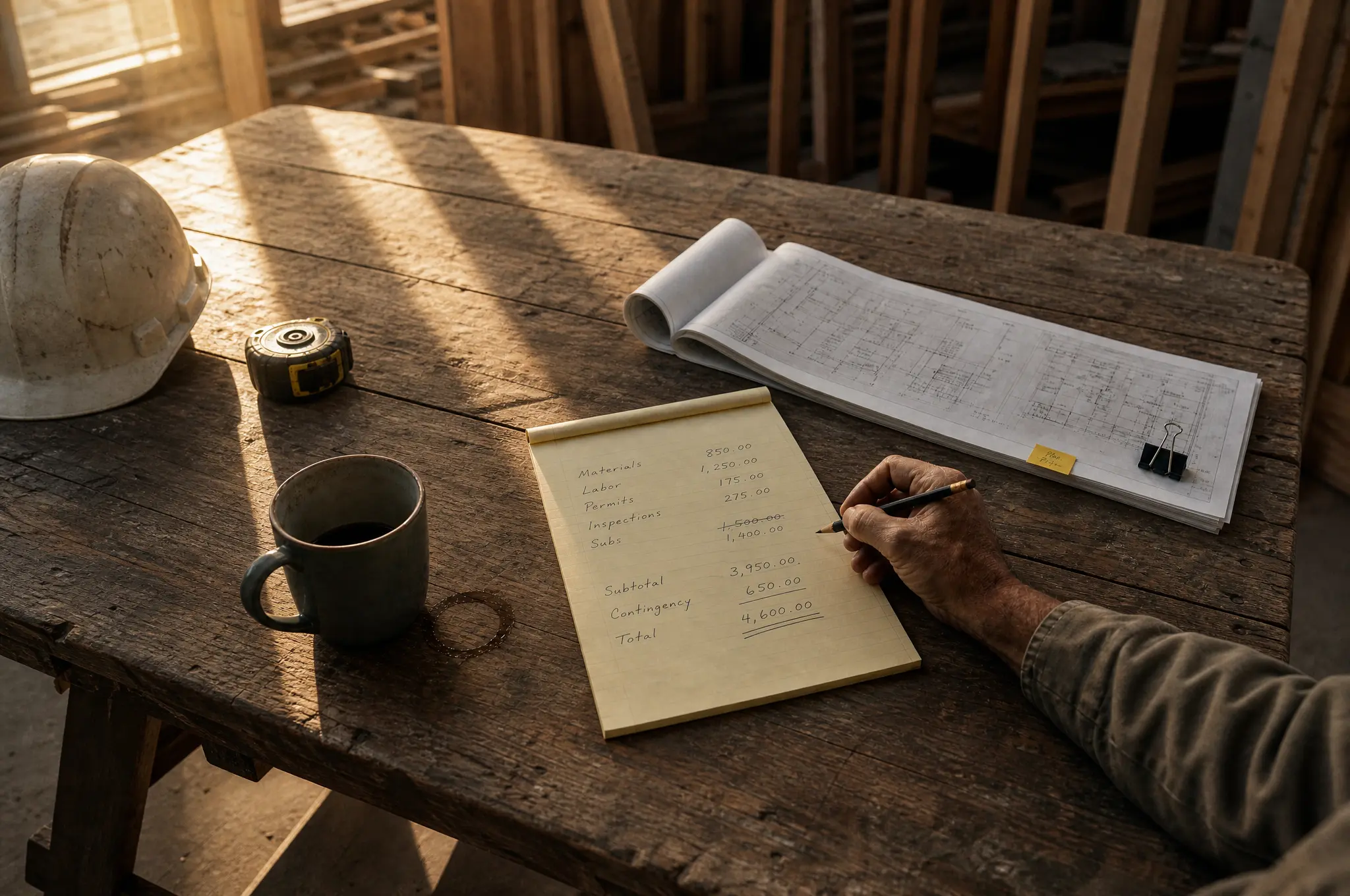
Most builders compare in-house drafting to outsourcing by hourly rate. That's the wrong comparison, and it's why the math never seems to add up. The real question isn't rate. It's what you're paying for capacity you don't always use.
Here's the comparison run properly, with actual numbers, for a custom builder doing six projects a year.
The real cost of in-house drafting
A full-time drafter looks like a fixed, predictable cost. It isn't. The salary is the smallest part of the story.
- Salary and benefits. The number everyone quotes.
- Software and hardware. Licenses, upgrades, the machine to run them, renewed annually.
- Training and ramp-up. Months before a new hire is fully productive.
- Downtime. The real cost. Between projects, you're still paying a full salary for a desk that isn't producing drawings.
That last point is the trap: in-house drafting is a fixed cost applied to a variable workload. You pay the same in your slow months as your busy ones. You just get less for it.
The worked example
Take a custom builder doing six projects a year, each averaging roughly $600K in construction cost.
Paid in full whether the pipeline is full or thin. If that drafter is realistically productive on 6 to 7 projects worth of drawings a year, the effective cost per project lands around $13,500 to $15,800, and that number gets worse in any year the pipeline is lighter than expected, because the salary doesn't shrink with it.
The outsourced alternative
At an 8 percent design fee on a $600K project, the full design-and-documentation scope runs roughly $48,000. Scoped to drafting-and-documentation specifically, outsourced costs for a comparable project commonly land in the $12,000 to $18,000 range, paid only on the projects that exist.
Why the industry-standard number matters here
A common outsourcing model runs around an 8 percent design fee, versus the 12 to 15 percent typical through more traditional channels. For a builder watching margins across six figures of annual design spend, that gap compounds fast, and it's on top of the fixed-cost problem above, not instead of it.
When in-house still wins
Outsourcing isn't automatically the right call. In-house can make sense when the following are true.
- You have consistent, high volume, enough to keep a drafter fully utilized every month, not just most months
- You need someone embedded in daily operations beyond drawings
- Drafting is a core identity you want fully under your roof
For a high-volume production builder, that math holds. For a custom builder doing 5 to 8 bespoke projects a year, it usually doesn't. The utilization just isn't there.
The question that actually matters
It isn't "in-house or outsourced." It's "am I paying for capacity I use, or capacity I carry?" An uneven pipeline, which describes most custom builders, means a fixed drafting cost is quietly subsidizing your slow months.
There's a factor the math alone won't show you: who's actually better at the drawings. A partner who's built draws differently than an in-house generalist, with fewer field surprises and fewer change orders. That doesn't show up as a line item, but it shows up in every project that doesn't stall.


